Beyond the Wrapper: Building Fault-Tolerant Multi-Agent Swarms
Tech12 min
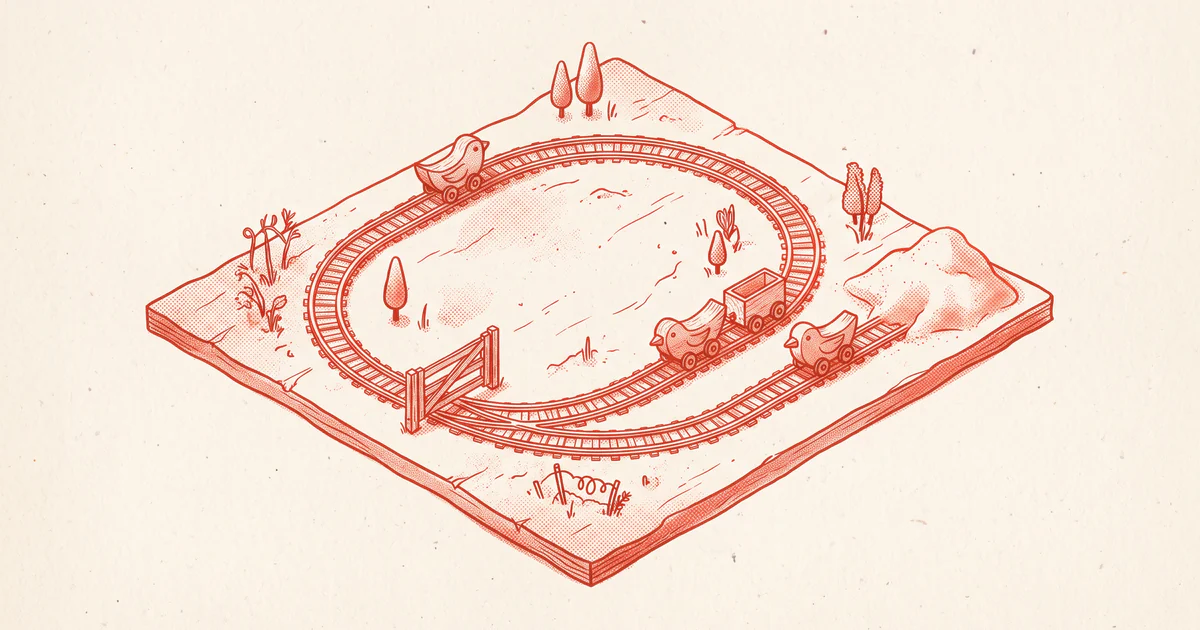
A chain of prompts cannot loop. Prompt A feeds prompt B feeds prompt C, and then it stops, because that is what a chain is. So when people say that chaining LLM calls leads to endless loops, they are describing something else: the moment they let the model decide what happens next. That is not a chain any more. It is a cyclic graph, and they built it without any of the machinery that makes cycles safe.
I think this distinction is the whole game, and almost every “multi-agent swarm” I see written up skips it. The swarm gets drawn as a cluster of friendly boxes with names like Planner, Researcher and Critic, arrows running between them in both directions, and the reliability story is a paragraph about better prompts. But a system where several processes pass messages, retry on failure, and share state is a distributed system. Its failures are distributed-systems failures: unbounded retries, lost state on crash, duplicated side effects, two components each assuming the other one checked. None of those are fixed by a better system prompt.
§The loop is in the graph, not the model
Context drift, the other half of the complaint, is real, and its source is more specific than people think. Every time one agent hands work to another, it hands over a summary. The summary is written by a model that has decided what matters, and the receiving agent cannot see what was left out. Do that four times and the fourth agent is working on a paraphrase of a paraphrase of the original request. Nobody hallucinated. Information simply leaked out at every hop, the way detail leaks out of a photocopy of a photocopy.
The loop and the drift share a cause. In both cases the control structure of the program lives inside text the model produces. Who goes next, whether the work is finished, what the task even was: all of it is carried in natural language and re-derived on every turn. Anthropic’s own taxonomy draws the line well. Workflows are LLMs and tools orchestrated through predefined code paths; agents direct their own process.[1] Most production systems I would trust are workflows with a few agentic pockets, and the pockets are where the bugs live.
So the move is not to make the agents smarter. It is to pull the control structure out of the transcript and into the program, where you can read it, bound it, test it and resume it. The single-agent version of this idea is in From Prompt Engineering to Control Flow. This piece is about what happens when there are several of them and they are allowed to cycle.
§Most swarms should be one agent
Before the engineering, the uncomfortable part. The best public case for multi-agent systems is Anthropic’s write-up of their research feature, and it is unusually honest about the price. Their multi-agent setup beat a single Opus agent by 90.2% on an internal research eval. It also burned roughly fifteen times the tokens of a plain chat, against about four times for a single agent.[2] They say plainly that the approach suits broad, parallel work like research, and is a poor fit where every agent needs the same context or where there are many dependencies between agents. They name most coding tasks as an example of the bad fit.
That is the strongest argument for swarms, made by people who shipped one, and it comes with a fifteen-fold bill and a list of places it doesn’t work. The academic picture is less kind. A Berkeley-led study annotated more than 1,600 traces from seven popular multi-agent frameworks, sorted the failures into fourteen modes, and opened by observing that performance gains over single agents on popular benchmarks are often minimal.[3] Their categories read like a post-mortem checklist: agents disobeying their role specification, agents withholding information from each other, agents unaware of when they are supposed to stop, nobody verifying the result before declaring victory.
Here is my rule of thumb. A second agent earns its place when it gets something the first one cannot have: a clean context window for a large, separable chunk of reading, a different set of tools, or different permissions. Parallel read-only fan-out (go look at these twelve sources and report back) is the good case. What does not earn its place is a second agent that differs from the first only in its system prompt. A “Critic” that is the same model, with the same tools, reading the same context, told to be skeptical, is role-play. Sometimes useful role-play. But you could get the same effect from one agent and a checklist, and the checklist does not cost you a handoff.
The word “swarm” does a lot of damage here. Swarms in nature work because each unit is cheap, local and dumb, and the behaviour emerges from many of them. LLM agents are the opposite: each one is expensive, each one sees a lot, and you very much do not want emergent behaviour from the thing issuing refunds. What you actually want is closer to a small team with a manager who keeps the minutes. So that is what I will build.
§Bound every cycle in state, not in the prompt
The most common loop in agent systems is the writer–critic cycle. One node drafts, another reviews, and if the review fails the draft goes back. It is a reasonable pattern. It is also an infinite loop the moment the critic has standards the writer can’t meet, which is often, because the writer and critic are frequently the same model and disagree with themselves in perfectly stable ways.
“Stop after three attempts” in the prompt is not a bound. It is a suggestion to something that cannot count reliably across turns. The bound has to be an integer in your state, checked by code. Here is the shape in LangGraph, which is a reasonable choice because it makes the graph explicit and ships the persistence primitives this needs:
from typing import Literal
from typing_extensions import TypedDict
from langgraph.graph import StateGraph, START, END
from langgraph.types import Command, RetryPolicy
from langgraph.errors import NodeError
from langgraph.checkpoint.memory import InMemorySaver

MAX_REVISIONS = 3

class State(TypedDict, total=False):
    task: str
    draft: str
    passed: bool
    feedback: str
    revisions: int
    failure: str

def write(state: State) -> Command[Literal["review"]]:
    draft = call_writer(state["task"], state.get("feedback", ""))  # your LLM call
    return Command(
        update={"draft": draft, "revisions": state.get("revisions", 0) + 1},
        goto="review",
    )

def review(state: State) -> dict:
    passed, feedback = run_checks(state["draft"])  # tests first, LLM judge last
    return {"passed": passed, "feedback": feedback}

def route(state: State) -> Literal["write", "publish", "escalate"]:
    if state["passed"]:
        return "publish"
    if state["revisions"] >= MAX_REVISIONS:
        return "escalate"
    return "write"

def on_write_failure(state: State, error: NodeError) -> Command:
    return Command(update={"failure": f"{error.node}: {error.error}"},
                   goto="escalate")
Three details matter more than they look. The revision counter is incremented by the writer node in code, so it cannot be argued with. The routing function is plain Python reading plain fields, so the decision to stop is not delegated to anyone’s judgement. And there is an explicit escalate exit. A bounded loop with no failure exit just turns an infinite loop into a silent one, where the third bad draft gets published because the counter ran out.
Notice also that write routes onward with Command(goto=...) rather than a static edge. That is deliberate. LangGraph’s docs are clear that a Command only adds dynamic edges and that static edges still execute, so if the writer had a static edge to the reviewer, I would not want to bet on what happens when its error handler also says “go to escalate”. Keep each node’s exits in one place.
Then there is the framework’s own circuit breaker. LangGraph raises GraphRecursionError when a run exceeds its recursion limit, and since 1.0.6 that limit defaults to a thousand super-steps.[4] A thousand steps of a model with tools is a very large number. It is a backstop against a runaway process, not a policy, and you should set it per run to something just above the longest legitimate path through your graph. Your state counter is the policy. The recursion limit is the fuse.
§Errors are edges
There are two kinds of failure in an agent graph, and they want opposite treatment. Transient failures (a timeout, a rate limit, a connection reset) should be retried with backoff, invisibly, a small fixed number of times. Logical failures (the draft is wrong, the tool returned nothing useful, the model refused) must never be retried blindly, because the same input will usually produce the same wrong answer, just more expensively.
The naive design handles both the same way: wrap the LLM call in a try/except and loop. The better design makes logical failure a state the graph can route on, and leaves retries for the plumbing. LangGraph 1.2 split these cleanly. A RetryPolicy on a node retries it, and a node-level error handler runs only after those retries are exhausted, receiving the failed node’s name and exception and returning a Command that says where to go.[5]
builder = StateGraph(State)
builder.add_node(
    "write",
    write,
    retry_policy=RetryPolicy(max_attempts=3, retry_on=TimeoutError),
    error_handler=on_write_failure,
)
builder.add_node("review", review)
builder.add_node("publish", publish)    # your side effect
builder.add_node("escalate", escalate)  # page a human, open a ticket
builder.add_edge(START, "write")
builder.add_conditional_edges("review", route)
builder.add_edge("publish", END)
builder.add_edge("escalate", END)

graph = builder.compile(checkpointer=InMemorySaver())  # PostgresSaver in prod
Retrying only on TimeoutError is a choice, and I think the right default. If the writer raises because the model returned something unparseable, I do not want three more identical attempts; I want the graph to go to escalate with the reason recorded in state. Where a malformed tool call is the problem, the fix belongs in the decoding and validation layer, which I take apart in Tool Use vs. Hallucination, not in a retry loop.
The reviewer deserves its own warning. If your check is another LLM call, your loop now terminates on the opinion of a model. That is sometimes the best you can do, but put every deterministic check you can think of in front of it: does it compile, do the tests pass, does the JSON validate, are the cited URLs real. An LLM judge at the end of a stack of cheap, certain checks is fine. An LLM judge as the only exit condition is how you get a cycle that converges on whatever the two models happen to agree on.
§Checkpoint like you expect to crash
A long-running agent will be interrupted. Deploys, OOM kills, a provider outage forty minutes into a task. Anthropic’s team found that restarting from scratch was too expensive and built their system to resume from where the agent was when the error occurred. They also deploy with rainbow deployments, keeping old and new versions running side by side, because a deploy can land on agents that are mid-task.[2] That last detail is the one I would put on a poster. A web request lasts a few hundred milliseconds. An agent run can outlive your release cycle.
In LangGraph the unit of resumption is a thread, and the checkpointer persists the graph’s state per super-step. You choose how eagerly: exit writes only when the run ends, async writes while the next step runs, and sync writes before the next step starts. If a node fails partway through a super-step, the writes from its siblings that finished are kept, so they are not re-run on resume.[6]
config = {
    "configurable": {"thread_id": "ticket-4812"},
    "recursion_limit": 12,  # longest real path is 2 * MAX_REVISIONS + 1
}
graph.invoke({"task": task, "revisions": 0}, config, durability="sync")

# after a crash or a deploy: same thread_id, no new input
graph.invoke(None, config, durability="sync")
For anything that touches the outside world, use sync and pay the latency. The failure you are protecting against is not losing a draft. It is resuming from a checkpoint taken before a side effect that actually happened, and doing it twice.
Which brings up the thing checkpoints cannot do for you. Resuming a graph replays from the last saved step, and if your publish node sent the email but crashed before its checkpoint landed, the resumed run will send it again. The fix is boring and old: every side effect carries an idempotency key derived from something stable, like the thread ID plus the node name, and the receiving system refuses duplicates. Payments people have done this for years. Agent people mostly have not, because a demo never crashes halfway through.
Put it together and the shape of a fault-tolerant multi-agent system is not very agentic at all. It is a graph you can draw on a whiteboard, with integer bounds on every cycle, a failure exit from every node that can fail, retries reserved for transient errors, state persisted before anything irreversible, and idempotent effects at the edges. The models live inside the nodes, doing the parts that need judgement. They do not get to decide whether the loop continues, and they do not hold the only copy of what the task was.
If that sounds like it drains the magic out, I would push back gently: it moves the magic to where it is useful. A model asked to write a good draft, inside a structure that guarantees the draft will be checked, bounded and recoverable, is doing the thing it is actually good at. A model asked to also be the scheduler, the retry policy and the source of truth is being asked to be a distributed system. It is not one, and neither is a swarm of them.
- ^Anthropic, December 2024. Workflows run on predefined code paths; agents direct their own process and tool use. Building effective agents.
- ^Anthropic, June 2025. The 15× figure, the 90.2% result, the early subagent sprawl and the resume-from-error design all come from How we built our multi-agent research system.
- ^Cemri et al., 2025. Fourteen failure modes in three groups (system design, inter-agent misalignment, task verification), from more than 1,600 annotated traces across seven frameworks. Why Do Multi-Agent LLM Systems Fail?
- ^The limit counts super-steps, not node calls, and has defaulted to 1000 since LangGraph 1.0.6. LangGraph Graph API.
- ^Node-level
error_handlerand per-node timeouts needlanggraph>=1.2. The handler only runs once the retry policy is exhausted. LangGraph fault tolerance. - ^Durability modes
exit,asyncandsync, and the pending-writes behaviour, are described in LangGraph checkpointers.