Supply Chain Collapses That Ended Civilizations: Lessons from the Late Bronze Age
History2 min
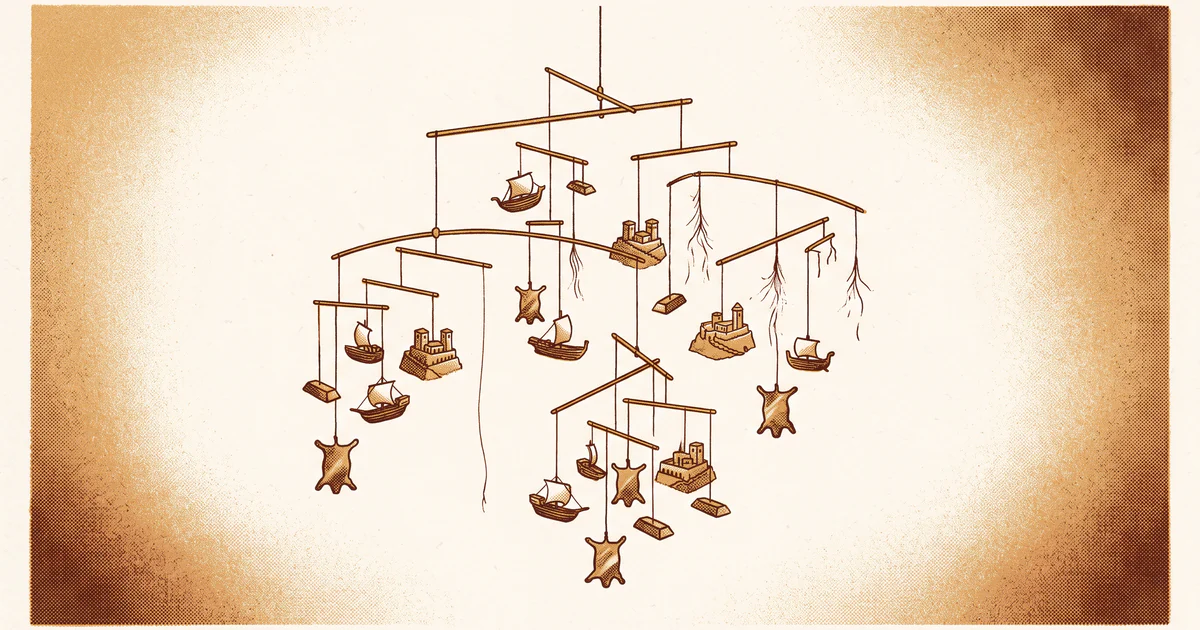
Some time around 1320 BCE a ship about fifteen metres long went down off Uluburun, on the south coast of what is now Turkey, carrying ten tonnes of copper and one tonne of tin. Ten to one is the recipe for bronze. The ship was not carrying metal so much as a bill of materials: enough raw input, already proportioned to spec, to keep a palace workshop busy for a very long time. It is the best snapshot we have of the network that ran the Late Bronze Age, and it went to the bottom more than a century before that network came apart.
The title of this piece says supply chains ended civilisations. That is the popular version, and I think it is wrong in an interesting way. The people who have spent careers on this period do not believe a trade disruption brought down the Hittites, the Mycenaean palaces and Ugarit in one go. They believe something messier, and much closer to how real systems fail. The supply chain is in the story. It just is not the villain. It is the wiring.
§A ship that was a parts list
The Uluburun wreck was excavated over eleven seasons from 1984, in more than 22,400 dives. What came up reads like the inventory of a whole economy. Roughly 348 copper ingots in the four-handled “oxhide” shape, about ten tonnes in all. Some 120 tin ingots, a tonne or so. Perhaps 175 ingots of coloured glass. Around 150 Canaanite jars of terebinth resin. Ebony logs, an elephant tusk, hippopotamus teeth, Baltic amber, an Italian sword, Mycenaean pottery, Mesopotamian cylinder seals, and scales and weights suggesting several merchants on board.[1]
The copper is the easy part. Lead isotope work puts most or all of it in Cyprus, the island the texts of the period call Alashiya. Cyprus was the Bronze Age equivalent of a large, reliable supplier with one dominant product. The tin is the hard part, and it is still being argued over.
In 2022 a team led by Wayne Powell ran lead isotope, trace element and tin isotope analyses on the Uluburun tin and concluded that about a third of it came from ores in what are now Uzbekistan and Tajikistan, with the remaining two thirds from the Taurus Mountains in Turkey, scraped from stream deposits and leftovers of older mining.[2] A year later Daniel Berger and colleagues published a rebuttal with a title that does not hedge: the Central Asian deposit at Mushiston, they argued, is chemically wrong for these ingots, and at least part of the cargo looks like it shares an origin with Bronze Age tin found in Israel and off the coast of Britain. South-west England, in their reading, is a very likely source.[3]
So the honest answer to “where did Bronze Age tin come from” is: a long way away, from more than one place, and we are not sure which. Pick either paper and the conclusion for this argument is the same. The metal that defined the age had no source anywhere in the core of the system. Every palace from Mycenae to Thebes depended on an input that arrived from beyond the edge of its known world, through intermediaries it did not control. Powell's team goes further and argues the tin moved through many small regional communities rather than being run by great states at all. If they are right, the kings were downstream of a supply chain they could not even see.
§Bronze is a dependency graph
Think of the Late Bronze Age Mediterranean as a handful of large services and a message bus. Egypt had grain and gold. The Hittites held central Anatolia and, through vassals, the coast of Syria. The Mycenaean palaces ran redistributive economies out of places like Pylos and Mycenae. Cyprus supplied copper. And ports like Ugarit, on the Syrian coast, were the routers: merchant houses, scribes who wrote in several scripts, ships for hire, and a king who was a Hittite vassal but traded with everyone.
The interface between the big nodes was the royal letter. Kings called each other “brother”, exchanged gifts that were really trade agreements, and complained when deliveries were short. One of the Amarna letters, from a king of Alashiya to the pharaoh, is close to a vendor apology email. He has sent 500 talents of copper, and he is sorry it is so little: the hand of the god Nergal has killed the men of his country, and there is not a single copper worker left. He would like silver in return, and payment for the timber Egypt has been receiving, and while he is at it, a specialist in eagle omens.[4]
That letter is a century and a half before the collapse, and nothing collapsed because of it. A plague hits the supplier, the shipment comes in light, the customer grumbles, the relationship continues. The system had shocks all the time, and it absorbed them. That is worth holding onto, because the popular story assumes the network was brittle by nature. It was not. It survived decades of local disasters. What it could not survive was a particular kind of disaster: many at once, correlated, landing on nodes that had already spent their slack.
§The slow version of a fast collapse
The hook for this article says the collapse happened in a single generation. It did not, quite. The destructions and abandonments are spread across several decades on either side of 1200 BCE, and the trouble starts earlier still: the Egyptian king Merneptah was already fighting Libyans with Sea Peoples among their allies decades before the famous battles. What is true is that the end, once it came, was fast at each site and permanent across the system.
Start with the weather. Tree rings from juniper timbers at Gordion, in central Anatolia, record three consecutive years of severe drought around 1198 to 1196 BCE, give or take a few years.[5] The Hittite heartland was landlocked and semi-arid, and it ran on grain. A drought there is not a bad harvest, it is an existential event for a state whose army and bureaucracy eat what the plateau grows.
Then follow the grain. In letters from Hittite officials found in a merchant's house at Ugarit, the empire leans on its vassal for grain shipments. Yoram Cohen and Eduardo Torrecilla, reading those letters in 2023, argue that Hittite demands probably made Ugarit's own food shortage worse shortly before the city fell.[6] Ugarit's last king, Ammurapi, wrote to the Egyptian pharaoh that there was a severe hunger in the land.[7] This is the part that should make any engineer sit up. The empire's answer to stress at the centre was to pull resources from the edge, which is exactly what you do when you have no reserve, and exactly how you turn one failing node into two.
Then the ships. In a letter to the king of Alashiya, Ammurapi describes enemy ships burning his towns, and explains why he could do nothing about it: his troops and chariots were in the land of Hatti, and his ships were in Lukka, on the south-west Anatolian coast. Seven enemy ships, he says, did great damage.[8] Another letter from the archive, probably never sent, reports invaders landing a few miles from the city and begs the Hittite viceroy at Carchemish for forces and chariots.[7]
Read that again as an incident report. The city's defensive capacity had been allocated elsewhere, to serve the larger system. Its food was being drawn down by the same system. The attack, when it came, was small. Seven ships. A healthy Ugarit with its own fleet at home shrugs that off. This Ugarit could not, and nobody resettled the site at any scale for centuries.
And then Egypt, around 1177 BCE in Eric Cline's dating, the eighth year of Ramesses III, who carved his victory over a coalition of Sea Peoples onto the walls of his temple at Medinet Habu. His inscription says no land could resist their arms, and names Hatti, Carchemish, Arzawa and Alashiya among the fallen.[9] It is a great line, and it is royal propaganda, and it has done a lot of damage to how this period gets told. It makes the Sea Peoples the cause. The better reading is that they were at least as much a symptom: displaced people on the move through a region where states were already failing, finishing off what drought, hunger and overextension had started.
§The title is wrong, the hook is half right
Cline's book 1177 B.C. is the standard modern account, and its argument is a systems argument. No single cause is enough. Drought, famine, earthquakes, invasion, internal revolt and disrupted trade routes all show up in the evidence, and the interdependence of the kingdoms is what made the collapse faster and deeper than any one of them would have been.[10] That is not the same claim as “a supply chain failure ended civilisation”, and the difference matters.
In the popular version, trade is the cause: the tin stopped, so the bronze stopped, so the armies and palaces stopped. There is an old, still-argued idea in this family, that tin shortages pushed smiths towards iron, and it may hold some truth about what came afterwards. But I find no good evidence that a trade interruption started the collapse. The evidence points the other way. Trade was the transmission mechanism. It is what took a drought in Anatolia and made it a famine at Ugarit; what took raiders on the coast and made them a crisis for Cyprus; what made every kingdom's bad decade everyone else's bad decade.
Anyone who has run production systems knows this failure mode. It is not the single dependency going down. Systems are built to survive that, and the Bronze Age one did, repeatedly, as the Alashiya letter shows. It is the correlated failure: shocks that would each be survivable, arriving together, through a topology where the nodes have already lent out their spare capacity. Retries, in this analogy, are the Hittite grain demands. Each one is rational for the caller and ruinous for the callee.
The part of the hook that is fully right is the ending. The palace-based world did not degrade, it went dark. In Greece the Linear B script, the bookkeeping system of the palaces, fell out of use with them. At Ugarit, as Cline put it to Archaeology:
Writing stops, everything stops, and no one comes back.
That is what interconnection buys you on the way down. A loosely coupled world loses a city. A tightly coupled one loses the institutions that knew how to rebuild it: the scribes, the merchant houses, the shipping relationships, the letters between brothers. The recovery takes centuries because the thing that failed was not a supplier. It was the protocol.
§Tin, again
The obvious modern parallel is semiconductors, and it is good enough that I want to be careful with it.
The shape matches. The most advanced chips depend on extreme ultraviolet lithography, a technology ASML describes as unique to itself. The light in those machines is made by hitting tiny drops of molten tin with a laser, tens of thousands of times a second, which is a detail I cannot stop enjoying. And the fabs that use them are concentrated: TrendForce put Taiwan at about 68 per cent of global capacity at 16 nanometres and below in 2023, and about 80 per cent of the processes that use EUV.[11] A critical input from a single specialised source, a manufacturing base concentrated in one exposed place, and every large power downstream of both. Mycenae would recognise it.
Where the parallel breaks is where most people take it. The lesson of 1177 is not “cut the tin and civilisation falls”. The Bronze Age system lost cargoes, suppliers and cities for centuries and kept running. The lesson is about correlation. The scenario worth worrying about is not a single fab outage, which the industry routes around badly but survives. It is a fab outage in the same year as a shipping crisis, a regional war and a bad harvest somewhere that matters, landing on governments and companies that ran their inventories to zero because slack looked like waste on a spreadsheet. The Bronze Age kings also thought their troops were better used in Hatti.
There is a version of the semiconductor argument that treats diversification as the whole answer, and I think it misses the Ugarit lesson. Ugarit was not short of partners. It traded with everyone. What it lacked was reserve: ships at home, grain in store, a garrison that answered to it. Redundancy across suppliers is one thing. Slack inside each node is another, and it is the one that gets optimised away first, because in normal years it does nothing at all.
The Uluburun ship is the right place to end, because it disproves the dramatic version of this story. A tonne of tin and ten of copper, the strategic metal of the age, lost in one afternoon on the rocks. Presumably some palace went without its bronze that year. And the system carried on for another hundred years, until the year when everything went wrong at once.
- ^Cargo figures from Mark Cartwright, Uluburun Shipwreck, World History Encyclopedia (2017), which summarises the excavation by the Institute of Nautical Archaeology under Cemal Pulak. Dates for the sinking vary between sources, from about 1330 to 1300 BCE.
- ^Wayne Powell, Michael Frachetti, Cemal Pulak et al., Tin from Uluburun shipwreck shows small-scale commodity exchange fueled continental tin supply across Late Bronze Age Eurasia, Science Advances 8 (2022), eabq3766.
- ^Daniel Berger, Kai Kaniuth, Gerhard Brügmann and Ernst Pernicka, Why Central Asia's Mushiston is not a source for the Late Bronze Age tin ingots from the Uluburun shipwreck, Frontiers in Earth Science 11 (2023). They are careful to call their own reading not conclusive either.
- ^Amarna letter EA 35, from the king of Alashiya to the pharaoh; a summary and translation are at Ancient Egypt Online. The tablet is in the British Museum.
- ^Sturt Manning et al., “Severe multi-year drought coincident with Hittite collapse around 1198–1196 BC”, Nature (2023); see the summary at Phys.org. The authors frame the drought as coincident with the collapse, not as proof that it caused it.
- ^Yoram Cohen and Eduardo Torrecilla, Grain Tribute in Hittite Syria and the Fall of Ugarit, Bulletin of ASOR 389 (2023), 65–73.
- ^The Ugarit Archives, Archaeology, July/August 2021, on the House of Urtenu tablets and the letters from the city's last years.
- ^The letter is published in J. Nougayrol et al., Ugaritica V (1968), pp. 87–90. I am working from the translation quoted in Wikipedia's article on Ammurapi, not from the edition itself.
- ^Joshua J. Mark, Sea Peoples, World History Encyclopedia (2009), which also covers Merneptah's fight with Libyans and their Sea Peoples allies decades earlier.
- ^Eric H. Cline, 1177 B.C.: The Year Civilization Collapsed, revised edition (Princeton University Press, 2021). The book is the backbone of everything in this piece that is not a primary text.
- ^ASML, EUV lithography systems; capacity shares from TrendForce, as reported by Paul van Gerven, Taiwan continues to dominate the leading edge, Bits&Chips, December 2023. TrendForce expected the share to fall towards 60 per cent by 2027 as other regions build.