The Paper Route: How Bureaucracy, Ledgers, and Double-Entry Bookkeeping Invented Capitalism
History10 min
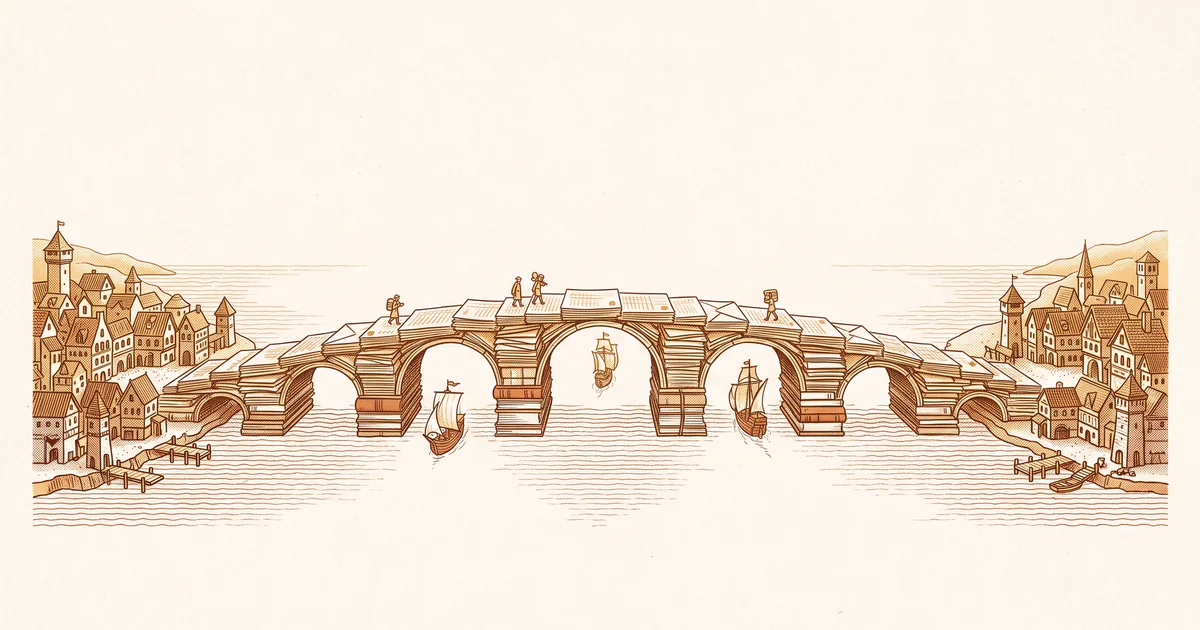
In 1922 Oswald Spengler named what he called the decisive event: the invention of double-entry bookkeeping by Fra Luca Pacioli in 1494. He added, via Goethe, that it was one of the finest discoveries of the human intellect, and that its author could be ranked with Columbus and Copernicus.[1] Almost every part of that sentence is wrong. Pacioli didn’t invent double entry, 1494 wasn’t the decisive moment, and the larger idea behind it, that bookkeeping made capitalism, is a thesis a careful economist took apart in 1949. And yet I keep coming back to the instinct behind it, because the instinct is right about something the details get wrong.
The title of this piece makes the strong claim on purpose. The version I can defend is smaller and, I think, more interesting: ledgers didn’t create the desire for profit, and they didn’t make merchants rational. They made trust portable. That was the bottleneck.
§Pacioli wrote the documentation, not the code
Pacioli was a mathematician and a Franciscan friar. His Summa de arithmetica, geometria, proportioni et proportionalita, printed in Venice in 1494, was a mathematics textbook with a section on how Venetian merchants kept their books. It is one of the first published descriptions of the method, with journals, ledgers, and accounts for assets, liabilities and capital. It is also where you will find the most relatable advice in the history of finance: don’t go to sleep at night until the debits equal the credits.[2]
But Pacioli was documenting a practice that already existed, and had for about two centuries. The earliest surviving European records kept in full double entry belong to a Florentine firm, Giovannino Farolfi & Company, headquartered at Nîmes in southern France. Its ledger for 1299–1300 was kept by a merchant named Amatino Manucci.[3] In 1340 the commune of Genoa kept its treasury accounts, the ledger of the massari, in double entry, and that ledger is one of the most famous government account books of the Middle Ages.[4] A Ragusan merchant, Benedetto Cotrugli, described the system in a treatise written in 1458, more than thirty years before Pacioli. His manuscript simply wasn’t printed until 1573, and the printer shortened and altered the bookkeeping section.[3]
So the man credited with the invention was the one whose book got printed first. If you have ever watched credit for a technique go to whoever wrote the clearest README, rather than the people who shipped it in production for years, you will recognise the pattern. Pacioli deserves real credit. Clear documentation is how a practice escapes the firm that developed it. But the code was already running in Tuscany and Genoa.
§The ledger is a checksum, and a weak one
Here is the part I find beautiful as an engineer, and it’s also the part that gets oversold. Double entry imposes one invariant: every transaction is recorded twice, as a debit to one account and an equal credit to another, so the sum across all accounts is always zero. In code it is almost embarrassingly small:
from collections import defaultdict

ledger = defaultdict(int)  # account -> balance in denari; debits positive

def post(debit: str, credit: str, amount: int) -> None:
    ledger[debit] += amount
    ledger[credit] -= amount

post("cloth", "cash", 120)           # buy cloth for cash
post("cash", "sales", 200)           # sell some of it
post("debtor:Bruges", "sales", 80)   # sell the rest on credit

assert sum(ledger.values()) == 0     # the trial balance
That final assertion is the trial balance, and it is a checksum on the whole firm. If a clerk records only half of a transaction, or adds a column wrong, the books stop summing to zero and you know something is broken before you know what. For a merchant with agents in five cities and nothing faster than a courier, that is an enormous gift. You can audit a stranger’s work without redoing it.
Now look at what the checksum can’t see:
post("debtor:London", "sales", 80)   # wrong debtor: still balances
post("cash", "sales", 500)           # sale that never happened: still balances
# a sale nobody recorded at all: still balances

assert sum(ledger.values()) == 0     # passes every time
A balanced ledger tells you the entries are internally consistent. It does not tell you they are true. Post to the wrong account, leave a transaction out entirely, or invent one with both sides filled in, and the trial balance is perfectly happy. A parity bit has the same limitation: it catches a single flipped bit and misses two. Most accounting fraud since has lived in that gap. The system detects carelessness, not intent.
This is basically the argument the economist Basil Yamey made in 1949 against the idea that double entry created capitalism. The method, he argued, looks backward rather than forward. It records what happened in an orderly way, which matters more as a business gets complex. But it was not designed to tell an owner which ventures would pay. It was neither necessary for commercial success (the Dutch East India Company seems to have managed without it) nor sufficient (plenty of firms with immaculate books went bust).[7]
§Sombart’s beautiful, overreaching idea
The thesis Yamey was attacking belongs to the German economic historian Werner Sombart. Sombart thought double entry was not a clerical convenience but the mental model of capitalism itself. In the passage Spengler quotes, Sombart says it is born of the same spirit as the system of Galileo and Newton
, an ordering of the world into pure quantities.[1] The argument is that once profit becomes a single abstract number on a page, separate from any particular bale of wool or ship, the idea of capital as a quantity that seeks to grow becomes thinkable.
I like this idea more than I believe it. The strong form, that capitalism could not exist without double entry, fails on Yamey’s evidence: big enterprises ran without it, and it was available for centuries before anything we would call industrial capitalism appeared. But the weak form survives. Bookkeeping changes what its users can see. A firm that tracks capital as one number will start asking what return that number earns. Tools shape the questions people know how to ask. Anyone who has watched a company reorganise itself around a dashboard metric has seen the effect in miniature.
§What the archives actually show
If you want to know what merchants did with paper, as opposed to what theorists said about it, the best evidence is the archive of Francesco di Marco Datini, a merchant of Prato who died in 1410. In 1870, during work on his old house, a stairwell gave up some 500 account books and around 150,000 papers.[5] That is the paper trail of an obsessive. He was away from home so much that he and his wife ran their marriage by letter for about twenty-seven years. A merchant does not keep 150,000 papers by accident. My reading is that the account books were the summary and the correspondence was the telemetry, the continuous stream of reports that made the summary worth trusting.
The Medici bank is the better systems case. Giovanni di Bicci de’ Medici founded it in Florence in 1397 with 10,000 gold florins. Over the next decades it opened branches in Rome, Venice, Geneva (later Lyon), Avignon, Bruges, London, Milan and Pisa. Each branch was a separate partnership. The Florentine parent held the majority stake, and the branch manager was a junior partner paid a share of profits rather than a salary. Partnerships were reviewed when the books closed and renewed if the numbers were good. Historians compare it to a modern holding company, and the comparison is fair.[6]
Look at what that structure does. It caps the blast radius: a failing branch is a failing partnership, not automatically a failing bank. It aligns incentives, because the manager eats his own losses. And it makes the annual closing of the books the control loop: the moment the centre decides whether to renew a branch. None of that works unless every branch keeps books the centre can read and trust. The ledger is the API between the head office and the edges.
The money itself moved on paper too. Church law prohibited usury, so the Medici earned most of their income from bills of exchange. Value was paid in one city and currency, and repaid in another city and currency some time later. The profit sat in the exchange rate and the delay, not in a line marked interest.[6] A bill of exchange is a promise that travels further than its signer and is honoured by people who have never met him, because his correspondents’ books say he is good for it. That, more than the debit-credit symmetry, is the paper route of the title: a network of ledgers that let credit move between Florence, Bruges and London without moving a single coin.
§Good books did not save the Medici
The Medici bank is also the cleanest counterexample to the idea that accounting is power. This was a bank run on paper, and it failed anyway. The London branch lent heavily to Edward IV and others during the Wars of the Roses, repayment collapsed, and the branch was wound up in 1478 with losses of about 51,533 florins. In Bruges, Tommaso Portinari lent to the Burgundian court and sank money into galleys, and Bruges together with the inherited London debts cost the bank more than 70,000 florins. Lorenzo de’ Medici leaned on his general manager, Francesco Sassetti, without checking his work. When the French invaded in 1494 and Florence threw the Medici out, the branches were dissolved.[6]
Assume every one of those losses was recorded correctly, with the debits equal to the credits. The ledger can tell you, accurately and in two columns, that you have lent a king more than he will ever repay. It can’t make you stop. That is Yamey’s point with a body count: bookkeeping is an instrument of observation, and observation is not judgement.
So did ledgers invent capitalism? No. Desire for profit is much older, the method is older than its famous textbook, and the people who wielded it best still went broke. What double entry and its companions really did was narrower and, for my money, more important. Bills of exchange, partnership contracts, branch accounts and a continuous flood of letters let a merchant trust people he could not see, and check their work without being in the room. Commerce at a distance became something you could audit. Everything we call finance is built on that.
The same theme runs through two other pieces here. Information Monopoly is about who controls the channels that this kind of information moves through, from print to the telegraph to search. The Geopolitics of Guano is about a nineteenth-century state that pledged its revenue to London creditors against a pile of bird droppings. That story ended the way the Medici one did. The books balanced until the asset ran out.
- ^Both the Spengler and the Sombart passages are quoted in John Ryan, “Historical Note: Did double-entry bookkeeping contribute to economic development, specifically the introduction of capitalism?”, Australasian Accounting, Business and Finance Journal 8(3), 2014. Spengler is also where the Goethe line comes from, by way of Wilhelm Meister.
- ^On Pacioli, the 1494 Summa and the rule about sleep, see Luca Pacioli.
- ^The Farolfi ledger and Cotrugli’s manuscript history are covered in Double-entry bookkeeping. The same article notes that the claim that Giovanni di Bicci de’ Medici introduced the method to his bank lacks evidence.
- ^Mikhail Kuter, Marina Gurskaya and Albert Gurskii, “Genoa 1340, Double Entry, and ‘Gold Coasting’”, De Computis 22(1), 2025. It is a close reconstruction of the commune’s 1340 ledger.
- ^Iris Origo, The Merchant of Prato (1957), is the classic book built from the archive. For the discovery and the size of the archive, see Francesco di Marco Datini.
- ^Raymond de Roover, The Rise and Decline of the Medici Bank, 1397–1494 (1963), is still the standard account. The figures here come from the summary in Medici Bank, which leans heavily on de Roover.
- ^Christopher Napier, “Basil Yamey: Historian of Accounting”, LSE. Yamey’s original paper is “Scientific Bookkeeping and the Rise of Capitalism”, Economic History Review, 1949.